Other core targets involved
Stakeholders involved: Employees, Park Enterprises
1. Energy Saving, Energy Creation
To meet the targets required by the “Executive Yuan's Electricity Efficiency Improvement Plan for Government Agencies and Schools”, the CTSP Bureau has implemented a series of power-saving measures in its administration building. These include replacing traditional lighting with energy-saving alternatives, managing the number of active office light fixtures based on occupancy schedules, and transitioning completely to LED lighting. As of 2025, all office fixtures have been replaced (with a total of 1,000 sets of 2-foot, 4-tube LED louvered troffers). Additionally, hallway lighting across all floors has been upgraded, replacing old fixtures with 35 sets of 2-foot, 2-tube LED batten fittings and 123 sets of LED recessed downlights. For air conditioning management, indoor temperatures are regulated between 26°C and 28°C, ice storage melting temperatures have been optimized, and system operating hours have been shortened. As a result, annual electricity consumption has steadily declined from 2.02 million kWh in 2009. In 2024 and 2025, the administration building's total annual electricity consumption was recorded at 1.72 million kWh and 1.64 million kWh, representing reductions of 14.9% and 18.8%, respectively, compared to 2009.
Furthermore, to enhance energy efficiency and reduce fuel consumption from official vehicles, all of the Bureau's leased vehicles have been switched to hybrid models, and an additional two electric vehicles were purchased in 2025. Annual fuel consumption has steadily declined from 8,266 liters in 2015. In 2024 and 2025, the total annual fuel consumption was recorded at 5,038 liters and 4,016 liters, representing reductions of 39% and 51%, respectively, compared to 2015.
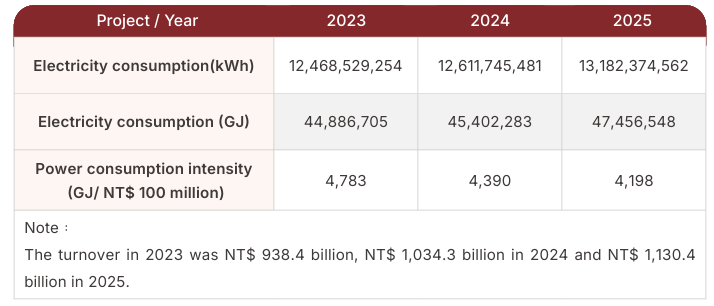
In accordance with the “Regulations for the Guidance and Control of Water and Electricity in Science Parks of the National Science and Technology Council”, the CTSP Bureau carries out the tracking, management, and dispatch of water and electricity usage for park tenants. To slow down the growth rate of overall power consumption across the park, the Bureau continues to provide energy conservation guidance and promotion. Since 2014, the Bureau has conducted annual on-site energy conservation guidance sessions, cumulatively assisting 55 companies through 2025. Given that energy consumption among park enterprises consists predominantly of electricity, these efforts have achieved a cumulative potential energy savings of 157,439 MWh per year (thousand kWh/year). Moving forward, the target is to increase the annual potential electricity savings by 4.3 million kWh each year. The park's electricity consumption data for the past three years are detailed below:
In response to the Solar Photovoltaic Promotion Plan launched by the Executive Yuan, the CTSP Bureau requires new tenant companies to evaluate their available roof space for solar PV installation during lease briefings, building permit pre-examinations, and power usage plan applications. Additionally, official notices have been issued to existing tenants, encouraging them to utilize current factory building surface areas to actively evaluate solar PV installations. The Bureau continues to hold annual solar PV promotional seminars and energy conservation guidance sessions. Specifically, solar PV installation promotional workshops were held on November 20, 2024, and October 29, 2025, to encourage park enterprises to accelerate the deployment of solar PV facilities. As of the end of December 2025, the total installed capacity across the park reached 79.68 MW.
2. Strengthen the toughness of power system
The Bureau adopts a dual-track strategy combining “Taipower's Grid Resilience Plan” with the park's own investments to comprehensively construct a power supply security guarantee for high-tech industries. By upgrading substation facilities, deploying smart grids and energy storage systems, and integrating diversified backup measures and renewable energy, we ensure that the park maintains stable operations even when facing natural disasters or unexpected contingencies. Furthermore, through the reinforcement of key power plants—such as the Taichung Power Plant—and dedicated line power supply mechanisms, power quality is guaranteed right from the critical facility end to safeguard industrial global competitiveness and national economic security.
In driving autonomous contingency response capabilities among park enterprises, significant results have already been achieved. For anchor tenants with a power demand of 25,000 kW or higher, the adoption rate of Energy Management Systems (EMS) has reached 100%, with a cumulative total of 15 plants having completed implementation, substantially enhancing energy regulation and control efficiency. Concurrently, the Bureau is actively promoting the transition to energy storage. At present, grid-connected energy storage systems built independently by park enterprises have reached 6.8 MWh and have entered Taipower's system impact review phase. The Bureau is also simultaneously evaluating the feasibility of establishing its own energy storage demonstration sites or pursuing public-private partnerships to reinforce the flexible regulatory capacity of the park's power grid.
Meanwhile, the Bureau has been promoting renewable energy development on parkland and land designated for management service facilities within the CTSP Erlin Park. Under the “CTSP Project to Strengthen the Promotion and Installation of Renewable Energy Facilities in Alignment with Government Policies,” proposals were solicited for the project. The Bureau partnered with Yi-Yun No. 2 Co., Ltd. and integrated the energy management expertise of Intelligent Cloud Plus Inc. and Ilum Energy Co., Ltd. (CTSP Branch) to jointly plan and install solar power facilities with a total installed capacity of approximately 1,200 kW. Phase I, with an installed capacity of 1.06 MW, has been completed, while Phase II, with a planned capacity of approximately 150 kW, is currently under development.
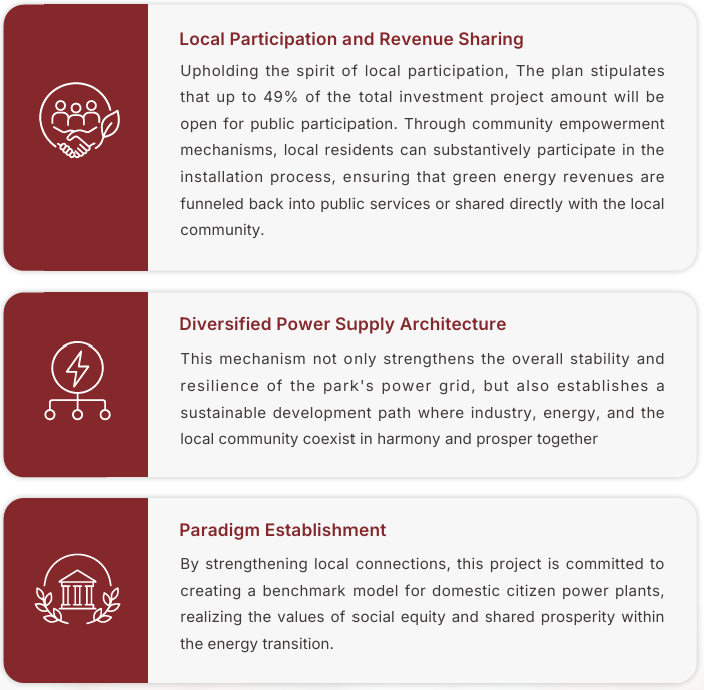
The core feature of this project lies in the innovative introduction of the "citizen power plant" model, with its specific value reflected in the following three major aspects: